By Mariana Barillas
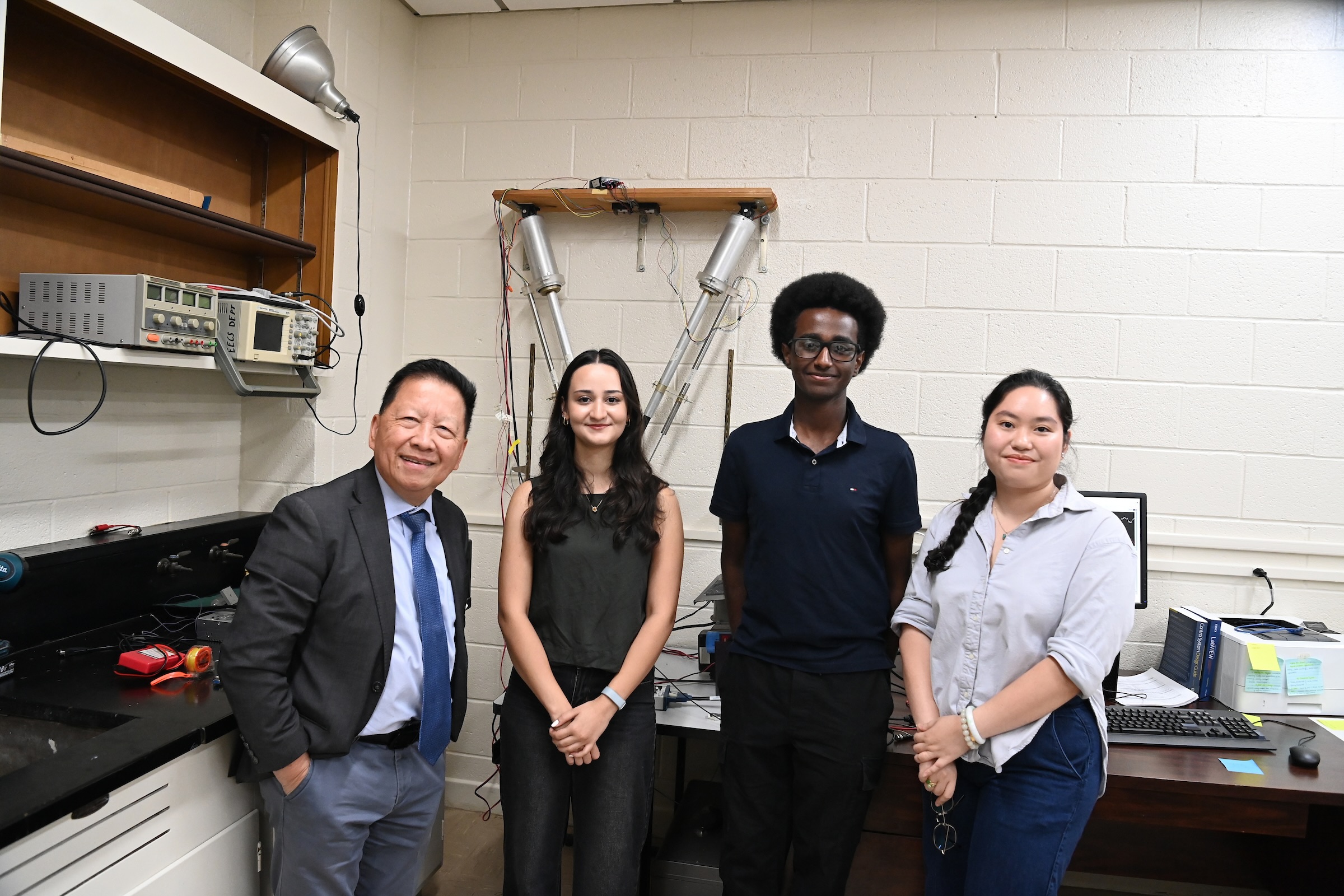
A small team of students revived a robotic arm first developed by Engineering Dean Emeritus and Ordinary Professor Charles Cuong Nguyen as proof of concept for technology that was considered by NASA to build the International Space Station. The team integrated new and advanced hardware and software into this testbed. Their award- winning ingenuity brought this foundational robot back to life, setting a vital milestone for ongoing research.
Professor Nguyen’s technology employs six degrees of freedom, meaning the machine has the dexterity to move by command to a wide variety of positions within a thousandth of an inch. It’s handy for nearly any task that requires hyper-precise movements.
The problem? The robotic arm built in 1982 has survived building renovations and even an earthquake, but much of the documentation has not.
Three students, including a high school Da Vinci Scholar, sleuthed out its secrets this summer. They spent weeks analyzing the arm, contacting manufacturers to identify parts and creating new operations software that incorporates AI learning. Finally, it’s alive.
“It’s astonishing what they’ve accomplished over just a few short weeks,” said Professor Nguyen.
Indeed, teams led by Professor Nguyen have been remarkably productive since he resumed teaching and research in 2018 after working as an administrator for 20 years including as department chair and engineering dean. His research team consisting of his former doctoral students and colleagues published 11 peer-reviewed technical papers in 2026 alone.
Team leader and biomedical engineering doctoral candidate Ha (Jessica) Ngo-Tang said she’s excited to start testing out applications for the arm to assist stroke victims. Professor Nguyen added that he sees opportunities to use the technology to train astronauts for zero gravity conditions.
Because of their hands-on work, these students deserve a round of applause.