Close Search Menu

Let Us Help

They Came for a Summer Research Program. They Didn't Want to Leave.

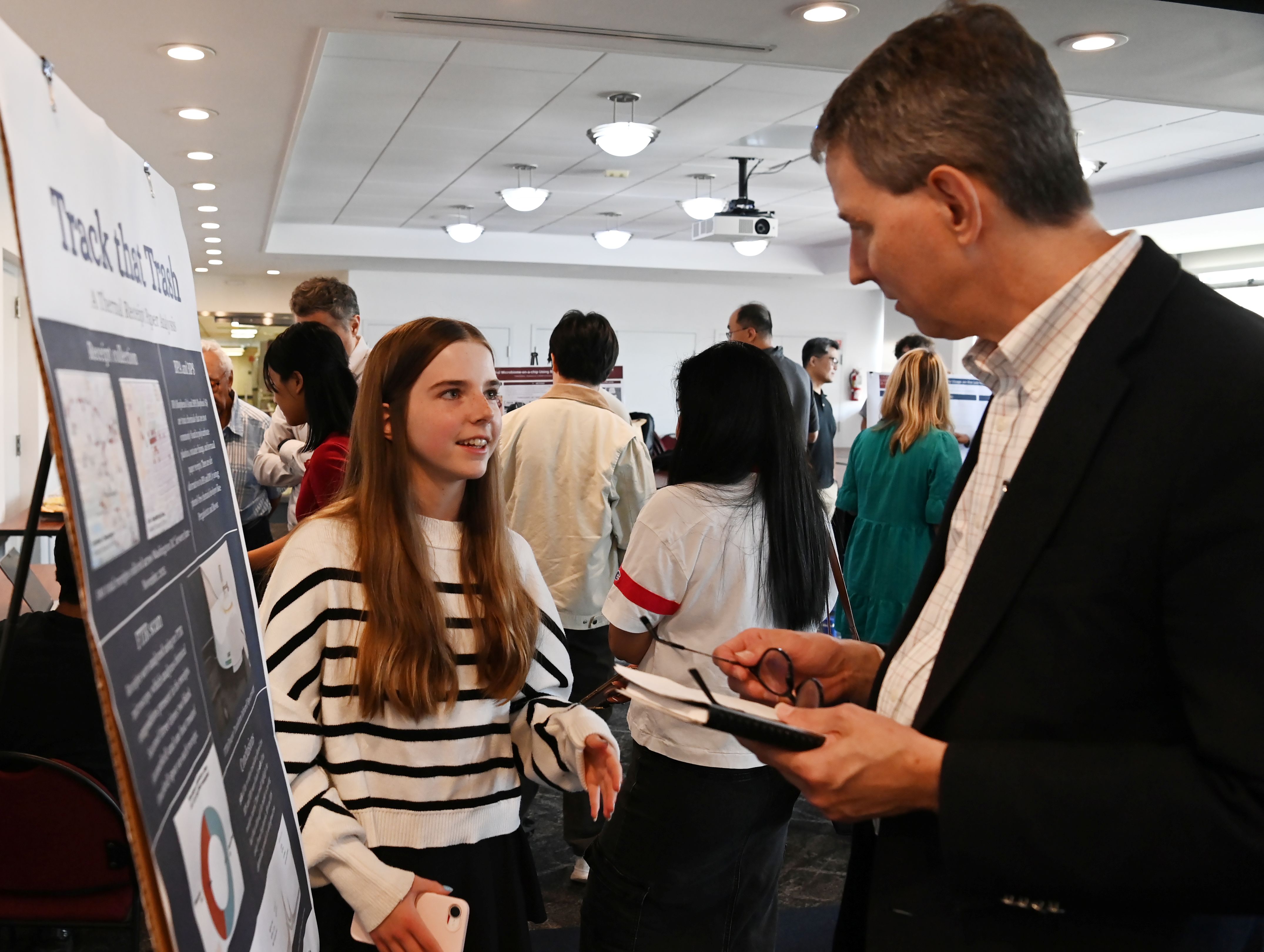
Engineering professor evaluates Da Vince Scholar's poster.

High school students learn research skills in engineering summer program—and ask to stay on

Twenty-one area high school students got a taste of college-level research this summer through the Da Vinci Scholars program, and one-third of them are coming back for more.

The Catholic University of America’s Da Vinci Scholars program is a summer research experience focused on engineering, science, computing, and innovation. Although the program concluded at the end of July, seven of the students requested to continue working with their research mentors through the end of the summer to continue their research, possibly preparing to enter it as a science fair project or publish a paper from the results.

Learning the basics of laboratory research

During the program, students researched a topic of interest to them, working in small groups and getting guidance from a faculty member, assistance from graduate students, and access to the laboratories. Formal meetings with their mentors happened weekly. Student projects covered a range of topics, such as looking at the effectiveness of a lithium ion battery; asking how turmeric (curcumin) and menthol work as a potential topical oil to help improve muscle recovery after exercise; and looking at particular biodegradable, naturally derived polymers as possible materials for direct methanol fuel cells, which are promising sustainable energy sources.

Alessandro Vato, associate professor of biomedical engineering, mentored four students who worked on projects focusing on brain-computer interfaces used in rehabilitation for stroke patients. Vato said he introduced his students to how research works by teaching them how to read a scientific paper and do a literature review, advising them on project timelines and team skills selection, and addressing a number of other related topics.   
Winning ideas

At the celebratory conclusion of the program, the student teams presented their research posters to faculty mentors and their parents. Three teams won the Outstanding Poster awards:

Lanny Huynh and Ronan Gunning (mentored by Sang Wook Lee, professor and chair of biomedical engineering) won for their poster, “Neural Binding in the Human Hand: Intermuscular Coherence Across Movement Tasks,” which relates to motor control of a prosthetic, such as those often used in therapy to retrain to body. 

Krish Stauber, Benjamin Lin, Riley Welch, Hieu Nguyen, and Zhaoyang Wang (mentored by Zhaoyang Wang, associate professor of mechanical engineering) won for their poster, “Real-Time Dense Three-Dimensional Reconstruction via Deep Learning Enabled Passive Stereo Vision.” Their research attempts to solve a computer vision problem, namely how to generate an accurate, dense 3D model of a scene from just two ordinary cameras without requiring expensive specialized hardware

Nathan Arega, Ha Ngo-Tang, and Saliha Kavafoglu (mentored by Charles Nguyen, professor and dean emeritus) won for their poster, “Experimental Evaluation of a Robust Disturbance Compensation Controller for a 2-DOF Parallel Manipulator.” Their research addresses the question of how a highly precise robotic arm can maintain its accuracy when unexpected forces affect its motion.

A labor of love for faculty volunteers

Rebecca Kiriazes and Jason Davison, both assistant professors of civil engineering, served as co-directors of the Da Vinci program this summer. Kiriazes explained that the program—which is offered for free to students—is possible only because the faculty mentors and students volunteer their time.

“It’s completely voluntary, and all 12 faculty are doing it just because they want to support the next generation of researchers. It’s definitely a labor of love to teach a high school student the ins and outs of a research project," she said.


Related News