John Grabowski, ordinary professor of moral theology and ethics at The Catholic University of America, recently spoke with us about his newest book, A Catholic Guide to Being Human, published July 6 by Our Sunday Visitor.
In conversation, Grabowski touched on several of the dehumanizing pressures that people face today and how these pressures create confusion in understanding who we are as human persons.
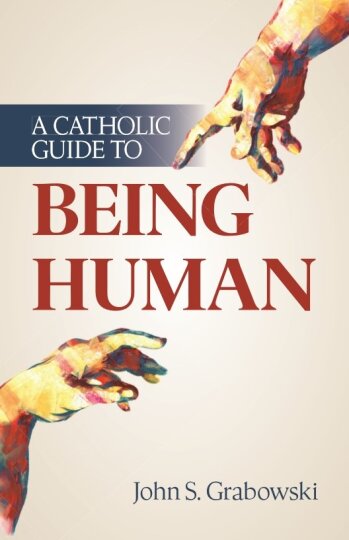
Written for “ordinary Catholics in the pews who want a fuller sense of why the church teaches and believes what she does about the dignity of every human person,” A Catholic Guide to Being Human provides a clear and accessible account of what it means to be human and to live a worthy life.
Q: What is it about our present age that obscures our understanding of what it means to be human?
I think there are two primary things. In the last couple of centuries, we’ve tended culturally to kind of forget about God and who God is, and we can’t fully understand who we are without reference to our Creator and our final end. The other thing is the growth in our science and technology. Over 60 years ago, the bishops of the Church, meeting at the Second Vatican Council, said the dilemma of the modern human being is we have all this powerful science and technology and we’re unlocking the mysteries of the universe – and yet we become more and more confused about who we are and, therefore, how to use that technology well. I think that’s only become more true in the 60 years since the Council ended.
Q: One of the mistaken ideas you try to correct in the book is the idea of person as function. Is that idea more pervasive today than in the past, and how problematic is it?
I do think it’s more prevalent today. The growth of our science and technology, for example, has made it easier for at least some people to look at other human persons and deny them full personhood. Why? Because they don’t meet the measurables, whatever those measurables are: whether that's the ability to live independently outside of the womb, the ability to reason and develop a certain level of IQ, the ability to be economically productive at a certain level. And that’s a sign of our present confusion.
Q: You also address our modern striving for perfection in this world, which you call “today’s secular version of the pursuit of sanctity.” Tell us a little more about that.
Sure. Again, I think it goes back to having forgotten God and having forgotten our proper end as human beings, which is to be with God for all eternity. Instead, we are trying to find a kind of secular, this-worldly substitute.
For some people, that's a technological pursuit of immortality. The ultimate example here is what the Transhumanists are proposing. But that then trickles out into the culture — we’re all trying to kind of find the right diet, the right exercise, the right kind of biohacking to extend our lives. And it’s kind of today’s version of asceticism: this is how I become a perfect human being. But just living longer is not the goal of my life. That’s not a worthy goal of any human life. We have to live for something beyond this world and beyond ourselves.
Q: Your introduction to the book mentions the importance of St. John Paul II’s account of the human person to your own study of the human person. How does his teaching shape the topics you chose to address in this book and the conclusions you offer?
The heart of St. John Paul’s teaching throughout his long pontificate, not just in his theology of the body, was the human person revealed in the light of Christ. When I was back in graduate school and I began to read his work, it was eye-opening because I had never thought of the human person as a deeply theological reality – that we could only really fully understand ourselves in the light of our faith. And then in encountering his thought, of course, I encountered the thought of Saint Thomas Aquinas and Saint Augustine and, behind them, Saint Paul and the teaching of Scripture.
So John Paul II was, for me, kind of a conduit into the heart of Catholic theology. He was a very, very deep thinker, so in this book, I’m trying to draw in a very modest way on some of his magisterial teaching and simplify it and offer it to people who don’t have extensive backgrounds in philosophy or theology.
Q: Who’s the primary audience for this book? And what do you most hope that your readers will take away from it?
The primary audience is ordinary Catholics in the pews who want a fuller sense of why the Church teaches and believes what she does about the dignity of every human person — the dignity of the unborn, the elderly, the handicapped, and able-bodied persons as well. What I hope people will carry away with them is the idea that to really understand ourselves, we have to turn to God. We can’t have a fully human life without a relationship with God, without a prayer life.
And we can’t have a fully human life through screens. Some people spend the majority or even the whole of their day immersed in a world of screens. That’s not reality. It’s not the real, interpersonal connection and communion that we're created for.
So, I really hope that people will read the book and say, “Oh, I need to spend less time on screens, more time on my knees. I need to spend less time on screens and more time with my spouse, my children, my grandchildren, my friends, and people around me in order to really have a full human life.”